Class 2 vs Class II Power Supply: Key Differences
Class 2 and Class II power supplies are defined by different safety standards and address different aspects of electrical protection.
Class 2 is designated by the NEC (National Electric Code) and focuses on a power supply’s output voltage, current, and power limitations. Class 2 power supplies also have wiring requirements for wire size, installation safety, and derating factors. These are all important in reducing fire and shock hazards.
In contrast, Class II is defined by the IEC (International Electrotechnical Commission) and relates to the power supply’s internal construction, specifically its double or reinforced insulation for shock protection.
What is Class 2 Power Supply and Its Power Specifications?
Class 2 Power Supply Definition
A Class 2 power supply or Class 2 power unit is a limited-power AC/DC power source. It complies with the UL 1310 standard and NFPA 70 NEC Article 725, ensuring that even in a fault condition, the output never reaches a hazardous level.
In many cases, Class 2 power supplies can be designed to also comply with the Limited Power Sources (LPS) designation under IEC 62368-1, since both standards restrict output power to reduce fire and shock hazards. That said, meeting one standard does not automatically guarantee compliance with the other.
Class 2 Power Specifications and Safety Limits
To qualify as a Class 2 power supply, the unit must operate within very specific electrical boundaries:
- The power capacity cannot exceed 100VA under both normal and fault operating conditions.
- The output voltage is typically limited to a maximum of 30V AC or 60V DC
- Current limits vary depending on the voltage level; for example, a 12V DC supply is limited to 5A, while a 24V DC supply is limited to 4.16A.
In terms of wiring, the wires of class 2 power supplies must be properly insulated to support permanent in-wall and under-floor installation without melting or cracking.
These restrictions are designed to prevent excessive heat generation, overload conditions, and dangerous fault currents. Many Class 2 units also include built-in protections such as overcurrent, short-circuit, and thermal protection to improve overall system safety.
Common Applications of Class 2 Power Supplies
So, what is a Class 2 power supply used for? Class 2 power supplies are widely used across various low-voltage systems that prioritize safety and reliability, ranging from commercial to industrial and residential environments. Typical applications include:
- Industrial Control: Powering sensors, human-machine interfaces (HMI), and PLC inputs where reliability and safety are non-negotiable.
- Building Automation: Managing HVAC controllers, smart thermostats, and security systems.
- LED Lighting: Acting as a driver for LED strips and architectural lighting to meet strict municipal fire codes.
- IoT & Communications: Providing safe, low-voltage power to routers, gateways, and smart sensors.
What is Class II Power Supply and Its Design Requirements?

Class II Power Supply Definition
A Class II power supply is an electrical power unit designed with enhanced insulation protection, as defined by the IEC. This is meant to ensure that no single failure in the power supply can result in dangerous voltage exposure to the user.
Class II Insulation Design and Safety Features
Class II power supplies are built with two independent layers of insulation between the user and internal live electrical components:
- Basic Insulation: The initial barrier applied to internal live parts, such as the insulation on internal wiring.
- Supplemental Insulation: An independent second layer that ensures protection if the basic insulation fails. It is often the high-impact plastic chassis itself.
Because of this insulation structure, Class II power supplies do not require a grounding wire to maintain user safety. Many designs also include increased spacing between conductive parts and insulated outer enclosures to further minimize the risk of electrical shock.
Common Applications of Class II Power Supplies
Class II supplies are preferred for environments where grounding is unreliable, unavailable, or potentially hazardous. They are usually used in:
- Medical Equipment: Under the IEC 60601-1-11 standard, the power supplies of medical devices intended for home use must be Class II. Examples include those of blood pressure monitors, nebulizers, and powered wheelchairs.
- Consumer Electronics: Most laptop adapters, smartphone chargers, and television power bricks are Class II to maintain high safety standards.
- Underground and Outdoor Appliances: Class II insulation provides a safer solution in damp or specialized environments like underground mining or garden lighting.
FAQs
What is a Limited Power Source (LPS)?
A Limited Power Source (LPS) is a safety designation defined by IEC. To qualify as an LPS, a power supply must be engineered to ensure its output does not exceed 100VA and its current remains within strictly defined limits, even under fault conditions. These constraints are designed to prevent the risk of fire and electrical shock.
What is the Difference Between Class I and Class II Power Supplies?
The main difference between Class I and Class II power supplies is how they protect users from electrical shock:
- Class I power supplies rely on basic insulation combined with a protective earth ground connection for safety. These units typically use a three-prong power cord.
- Class II power supplies use double or reinforced insulation and do not require grounding, allowing them to operate safely with a two-prong power cord.
How to Tell If the Power Supply is Class 2 or Class II?
You can usually identify the classification by checking the product label and safety markings on the power supply:
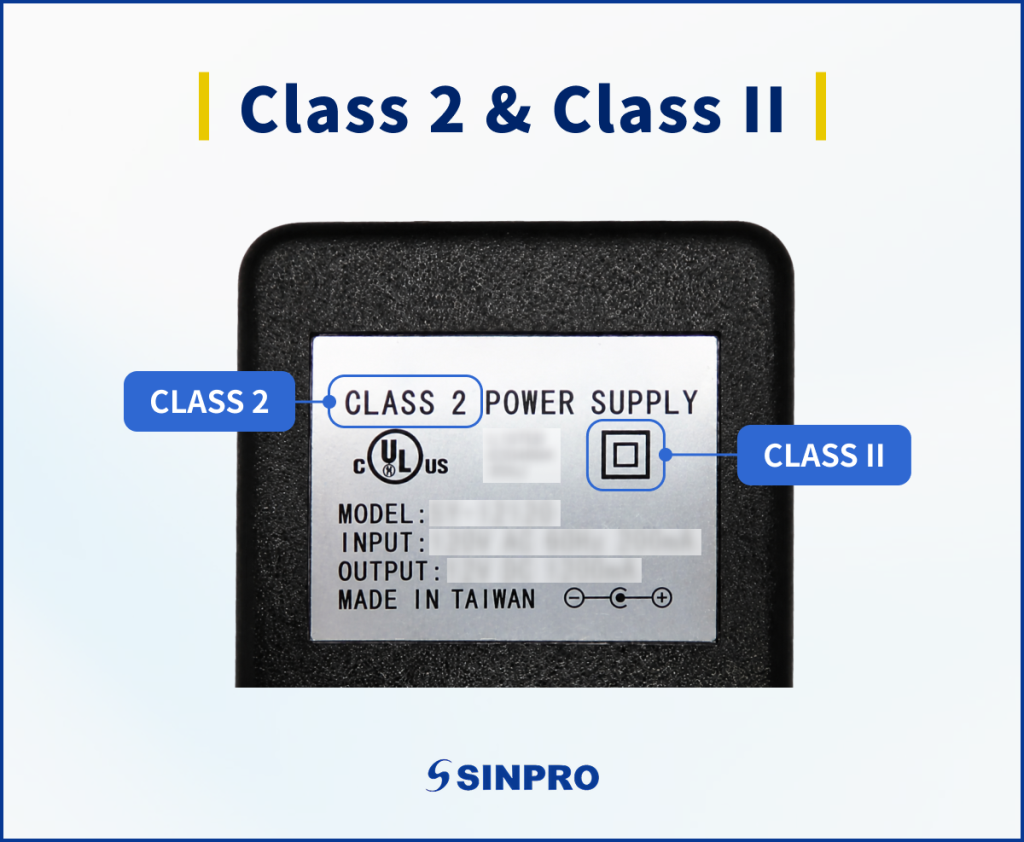
- A Class 2 power supply is often labeled “Class 2 Power Supply” or “Class 2 Power Unit,” indicating compliance with UL1310 and NEC power limitation requirements.
- A Class II power supply is typically marked with the double-insulated symbol, which looks like one square inside another square. Class II models also commonly feature a two-prong plug without a ground connection.
Sinpro: Your Power Supply Manufacturer for High-Quality Solutions
Sinpro is a professional power supply manufacturer specializing in high-reliability AC/DC solutions for demanding industries such as medical equipment and electric vehicle (EV) systems. With a strong focus on safety compliance and precise engineering, Sinpro designs power supplies that meet global standards for performance and long-term stability.
Featured Class 2 and Class II Power Supplies
- Designed to meet Class 2 compliance
- Class... II compliant
- Designed to meet Class 2 compliance
- Class II compliant
Sinpro’s HPA65, HPA90, and HPA120 series are designed for universal applicability, supporting ITE (IEC 62368), medical (IEC 60601), household (IEC 60335), and industrial (IEC 61558) systems. This allows SKU consolidation across projects and simplifies supply chain management.
All models are rated for Overvoltage Category III (OVC III), enabling direct connection to the power grid with strong surge resistance and eliminating the need for additional isolation in industrial environments.
In addition, our rigorous Impedance Stabilization Network (ISN) testing ensures clean signal integrity with minimal electromagnetic interference, making the power supplies suitable for sensitive communication and data systems.
Sinpro’s HPA65, HPA90, and HPA120 series are designed for universal applicability, supporting ITE (IEC 62368), medical (IEC 60601), household (IEC 60335), and industrial (IEC 61558) systems. This allows SKU consolidation across projects and simplifies supply chain management.
All models are rated for Overvoltage Category III (OVC III), enabling direct connection to the power grid with strong surge resistance and eliminating the need for additional isolation in industrial environments.
In addition, our rigorous Impedance Stabilization Network (ISN) testing ensures clean signal integrity with minimal electromagnetic interference, making the power supplies suitable for sensitive communication and data systems.
Our HPA65 and HPA90 series are also certified under:
- IEC 62368-1 (CB, UL, TÜV)
- IEC 60601-1 (CB, UL, TÜV)
- CE, UKCA, FCC, PSE, CCC, BIS (12V & 24V), and LPS for global export
Why Choose Sinpro?
Sinpro delivers accelerated time-to-market through responsive technical support and streamlined logistics. We even offer customization services that allow electrical and mechanical adjustments tailored to your exact system needs. On top of that, built under ISO 13485 and ISO 9001, every unit we produce undergoes 100% burn-in testing, ensuring high reliability and long-term operational stability.
Reach out to discuss your project requirements today!
Browse our power supply solutions today, or reach out to discuss custom requirements!
Contact Us