Switching Power Supply Explained:
How It Converts Power
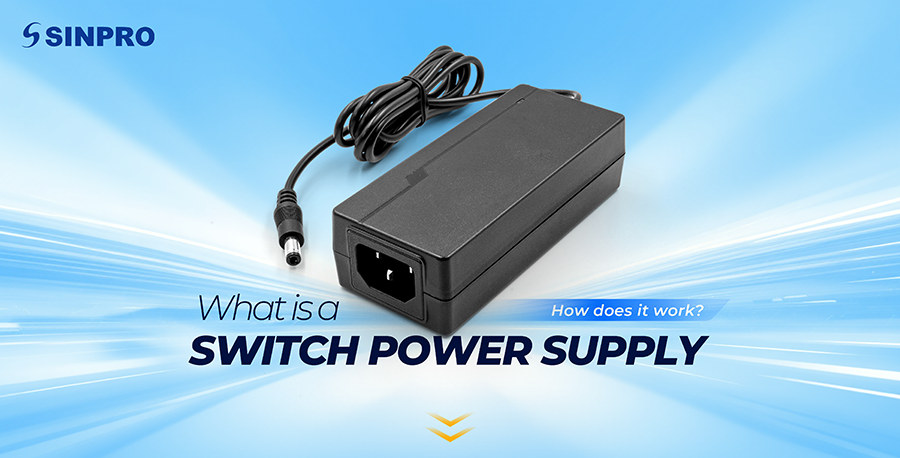
Switching power supply is essential for converting electrical energy with maximum precision and minimal waste in various devices, from the smartphones in our pockets to sophisticated medical imaging systems. But what is a switch-mode power supply, and why has it largely replaced older technologies?
This guide will dive into the fundamentals of switching power supplies and explain how it differs from traditional linear models. We will also walk through the step-by-step process of high-frequency conversion, explore its primary advantages in industrial applications, and answer some FAQs.
What is a Switching Power Supply?
A switching power supply (also known as a switched mode power supply, SMPS) is an electronic power supply that uses a switching regulator to efficiently convert AC electrical power into a stable, regulated DC voltage.
Instead of acting like a partially closed valve that burns off excess energy as heat, an AC/DC switching power supply functions more like a high-speed digital gate. It rapidly toggles power components on and off at frequencies reaching 20 to 500 kilohertz.
Linear vs Switching Power Supplies: How Do They Differ?
Linear and switching power supplies regulate electrical power in fundamentally different ways.
A linear power supply first reduces AC voltage using a transformer, then rectifies and filters it into DC. Any excess voltage is dissipated as heat through a linear regulator, which makes the design simple but inefficient and bulky.
In contrast, a switching power supply first converts AC to DC, then uses high-speed semiconductor switching to chop the DC into high-frequency pulses. These pulses are processed through a small high-frequency transformer or inductor before being filtered into a stable DC output. This switching method significantly improves efficiency and allows for compact designs, but introduces more electrical noise and design complexity.
Key Differences Between Linear and Switching Power Supplies
| Aspect |
Linear Power Supply |
Switching Power Supply |
| Efficiency |
Low (~30–50%) due to heat loss |
High (~80–95%), minimal energy waste |
| Size & Weight |
Large and heavy (bulky transformer) |
Compact and lightweight (high-frequency operation) |
| Noise (EMI/Ripple) |
Very low output noise |
Higher noise, requires filtering |
| Heat Generation |
High heat dissipation |
Low heat output |
| Complexity |
Simple circuit design |
More complex control and switching circuitry |
| Input Voltage Range |
Limited flexibility |
Wide input range (e.g., universal AC input) |
| Cost-Effectiveness |
Cost-efficient at low power levels |
More economical for medium to high power applications |
Overall, linear supplies are preferred for low-noise precision systems, while switching designs dominate modern electronics due to their efficiency, scalability, and smaller form factor.
How Does a Switching Power Supply Work: Step-by-Step Breakdown
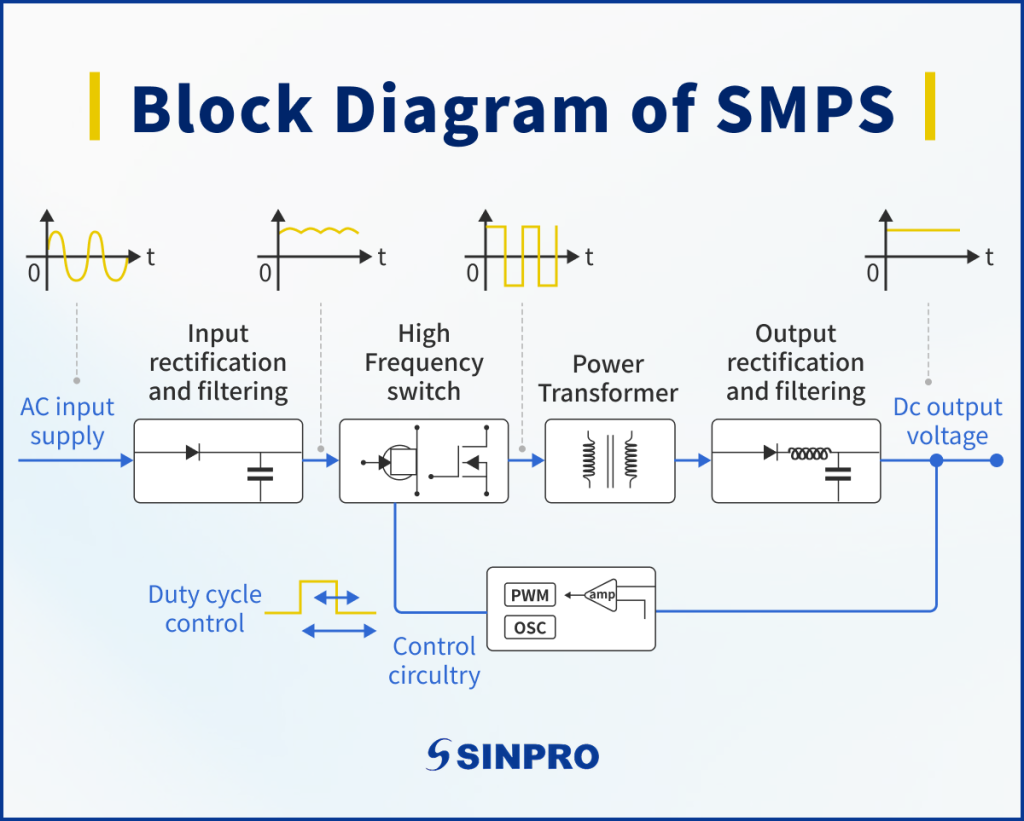
Now, let’s go through a detailed breakdown of a switching power supply’s internal mechanism from input to output.
1. Input Rectification and Filtering
The process begins with AC input rectification, where incoming alternating current, typically 100-240V AC at 50Hz or 60Hz in universal designs, is converted into an unregulated DC waveform using a diode bridge. This stage ensures current flows in one direction only, producing a pulsating DC signal rather than a smooth voltage, so it is still not suitable for direct use.
To stabilize this waveform, a large electrolytic reservoir capacitor, often called a bulk smoothing capacitor, is used to store energy between AC cycles. It charges during the voltage peaks and discharges when the rectified wave drops, smoothing out the massive ripples into a high-voltage DC bus.
Simultaneously, an input filter, comprising chokes and X/Y capacitors, works to prevent electromagnetic interference (EMI) generated by the power supply from leaking back into the mains grid, ensuring compliance with global regulatory standards.
2. Power Factor Correction (PFC)
In many modern power supplies, especially those rated above 75W, an important stage called Power Factor Correction (PFC) is added as required by IEC 61000-3-2. Its purpose is to reshape the current so it more closely follows the input voltage waveform, improving how efficiently the power supply draws energy from the grid.
Without PFC, the smoothing capacitors would only draw current at the very peaks of the AC cycle, creating sharp current spikes. These spikes reduce efficiency and potentially damage other equipment.
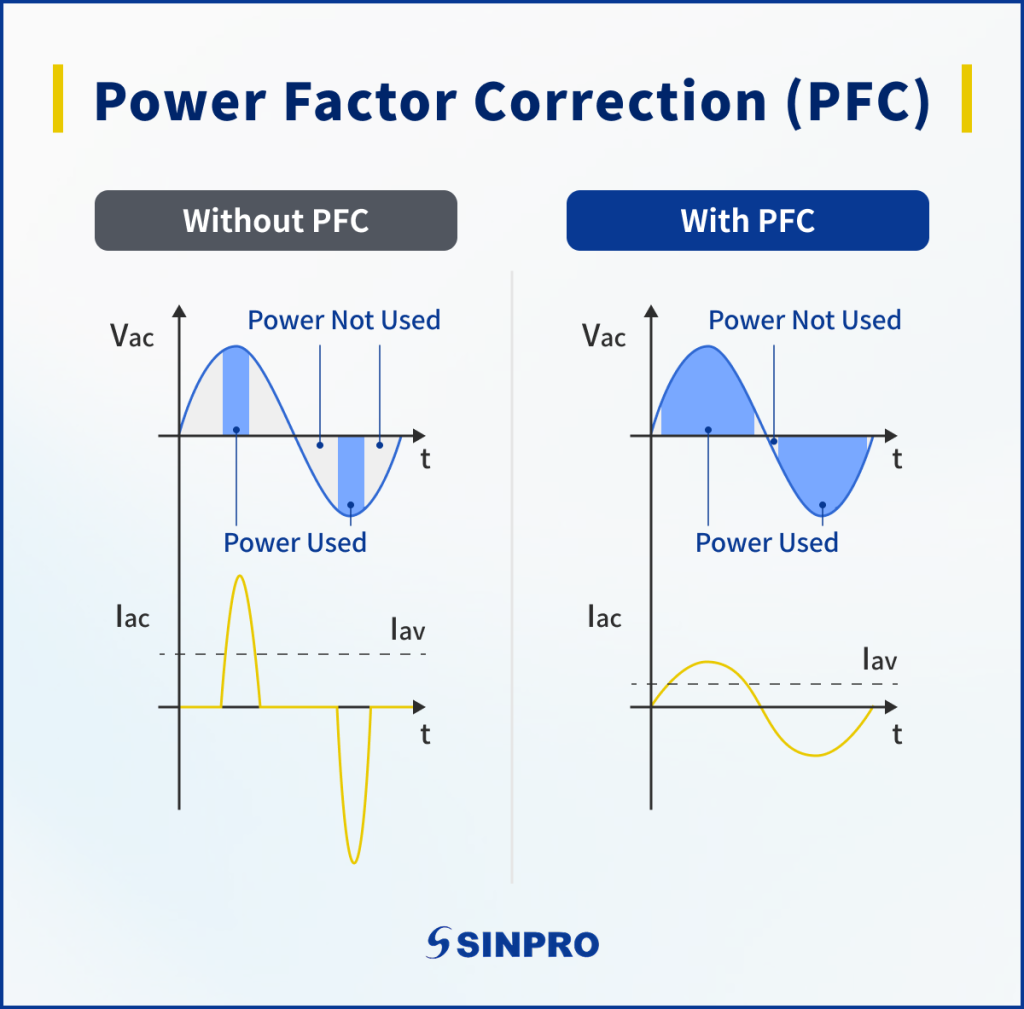
The PFC process can either be passive or active.
- Passive PFC: Uses large inductors to manually smooth the current waveform. While simple, it is bulky and less effective at reaching high power factors.
- Active PFC: Typically uses a controlled boost converter to actively regulate and smooth the input current. This brings the Power Factor (PF) close to unity, typically 0.95 or higher, with high-efficiency designs reaching 0.99, ensuring that the device uses nearly 100% of the energy it draws from the grid.
3. High-Frequency Switching (The Chopper)
Once a stable DC bus is established, the power supply enters the switching stage, often called the chopper. Here, semiconductor switches, such as MOSFETs, IGBTs, or modern Gallium Nitride (GaN) transistors, rapidly turn on and off at very high frequencies, typically between 50 kHz and 1 MHz+, depending on design. This rapid switching "chops" the steady DC into a high-frequency square wave.
By varying the duty cycle (the ratio of time the switch is 'on' versus 'off') through Pulse Width Modulation (PWM), the power supply can precisely control how much energy is transferred to the next stage. This high-speed operation is the secret to the SMPS's high efficiency; since the transistor is either fully on (no resistance) or fully off (no current), it dissipates virtually no energy as heat.
4. Voltage Transformation
The high-frequency switching signal is then fed into a small ferrite-core transformer or inductor-based magnetic component. This performs step-down conversion for low-voltage electronics (e.g., 12V, 24V systems) or step-up conversion for other applications.
As the frequency of the signal increases, the physical size of the transformer required to transfer a specific amount of power decreases. A 100kHz transformer is a fraction of the size and weight of a 60Hz transformer.
The transformer also provides galvanic isolation. There is no direct electrical connection between the high-voltage input (primary) and the low-voltage output (secondary). Instead, energy is transferred via magnetic fields, protecting the end-user and the load from lethal mains voltages.
5. Output Rectification and Smoothing
After transformation, the signal is still high-frequency AC, so it must be converted back into stable, low-voltage DC (such as 5V, 12V, or 24V). This is done through output rectification, typically using fast diodes or synchronous rectification circuits on the secondary side of the transformer.
Following rectification, output capacitors and LC filters smooth the waveform, removing residual ripple and stabilizing the voltage. The final result is a clean, regulated DC output suitable for sensitive electronic loads.
To ensure the output remains stable despite changes in load or input voltage, an optocoupler sends a signal from the output back to the primary-side controller. This allows the "Chopper" to adjust its PWM duty cycle in real-time, maintaining a rock-solid voltage for the connected device for consistent performance.
What are the Pros and Cons of Switching Power Supplies?
Switching power supplies offer major advantages, especially in efficiency and size, but they also introduce technical trade-offs that engineers must carefully manage.
Switching Power Supply Benefits
- High Energy Efficiency: By toggling power rather than resisting it, these units reach 80% to 95% efficiency, significantly reducing heat waste and electricity costs.
- Compact Footprint: High-frequency switching allows for smaller magnetic components, resulting in a lightweight design that fits into tight industrial enclosures.
- Wide Input Range: Most professional models offer universal input ranges, such as 85-265VAC, enabling reliable operation across global power systems.
- High Regulation: PWM-based control enables stable voltage regulation even under fluctuating load conditions, helping maintain consistent output performance.
- Multilayer Protection: Modern SMPS units often integrate safety protocols like Short Circuit Protection (SCP), Overload Protection (OLP), Overvoltage Protection (OVP), and Overtemperature Protection (OTP) to protect sensitive downstream equipment.
Switching Power Supply Challenges
- Electrical Noise (EMI): High-speed switching generates electromagnetic interference that may affect nearby electronics if filtering and shielding are insufficient.
- Ripple: Residual switching ripple can appear at the output voltage, which may impact highly sensitive analog or audio applications without proper filtering.
- Design Complexity: Compared to linear designs, switching power supplies require more advanced control circuitry, component selection, and EMI management during development.
What is a Switching Power Supply Used For: Main Applications
The versatility of SMPS technology makes it the preferred choice for sectors requiring high performance in a small form factor. Common switching power supply applications include:
- Medical Equipment: Used in diagnostic devices, patient monitoring systems, imaging equipment, and other applications requiring reliable, regulated power.
- Automotive and EV: Supports EV charging systems, onboard electronics, battery testing, and power conversion modules.
- Industrial Systems: Powers automation equipment, robotics, CNC machinery, and industrial control systems.
- Consumer Devices: Integrated into laptops, gaming systems, smartphones, adapters, and household electronics.
- Aerospace and Defence: Preferred for avionics and mission-critical systems due to their lightweight, high-efficiency design.
More Switching Power Supply FAQs
Q1. What are the common SMPS topologies?
Depending on your voltage requirements, power levels, efficiency goals, and isolation needs, different designs are used:
- Buck Converters: These are non-isolated, step-down converters. Because they only require a single inductor rather than a transformer, they are incredibly efficient. They are ideal for point-of-load regulation in IoT sensors and LED lighting.
- Boost Converters: Functioning as step-up converters, these increase the input voltage to a higher level. They are most frequently used in battery-powered devices, LED drivers, and automotive electronics.
- Flyback Converters: This is an isolated topology that uses a transformer for both energy storage and voltage scaling. It is highly cost-effective for low-power applications typically under 100W (depending on design requirements), such as chargers and small medical devices.
- LLC Resonant Converters: Designed for medium- to high-power applications, these isolated converters use soft switching to turn transistors on/off when current is near zero. This drastically reduces heat and EMI, making them ideal for server power and industrial automation.
Q2. Are switching power supplies safe to use?
Yes, switching power supplies are generally very safe when designed correctly and certified. As mentioned, modern SMPS units commonly include protection mechanisms such as OVP, OLP, SCP, and OTP. Many isolated designs also use transformers to provide galvanic isolation between the input and output, improving user safety and reducing electrical risk.
Q3. How to choose the right switching power supply?
Selecting the ideal SMPS requires balancing technical specifications with long-term reliability. Begin by matching output voltage and current to your system’s peak load, ideally allowing for a 20%-30% power margin to account for efficiency ratings and thermal management, especially for fanless or enclosed environments.
Last but not least, ensure the manufacturer holds relevant safety certifications like UL, CE, or IEC. This signifies the power unit meets strict global requirements for isolation and electromagnetic compatibility, shielding your equipment and users from potential hazards.
Find High-Quality, Reliable Switching Power Supply at Sinpro
Sinpro is a leading switching power supply manufacturer and developer, specializing in high-reliability AC/DC solutions for demanding industries such as medical equipment and electric vehicle (EV) systems.
With a strong focus on global safety compliance and engineering precision, Sinpro delivers power solutions designed for stability, efficiency, and long-term performance in high-stakes applications.
Featured Switching Power Supply Series
External Solutions
Highly reliable external switching power supply solution meeting global standards.
Advanced power adaptation with enhanced safety for diverse operating environments.
Robust power delivery with strict compliance for sensitive electrical equipment.
Internal Solutions
Open-frame internal switching power supply designed for compact integration.
High-power internal solution supporting universal input ranges for global deployment.
HKA600 Series
Ultra-high power density in a low-profile 1.50" design, up to 600W output.
Sinpro’s products are built for universal applicability, even in the most demanding environments, supporting multiple standards across ITE (IEC 62368), medical (IEC 60601), household (IEC 60335), and industrial (IEC 61558) systems. This allows OEMs to simplify SKU management and streamline global product deployment.
All key models are rated for Overvoltage Category III (OVC III), enabling direct connection to the power grid with strong surge protection. In addition, our rigorous ISN (Impedance Stabilization Network) testing ensures clean signal integrity with minimal conducted interference, making the power supply suitable for sensitive data and communication environments.
Furthermore, the HKA600 series comes with a low-profile 1.50" design, up to 600W output, and efficiency reaching 95%. It is also conduction-cooled, providing a specialized solution for environments where silent, fanless operation is a necessity.
Sinpro’s products are built for universal applicability, even in the most demanding environments, supporting multiple standards across ITE (IEC 62368), medical (IEC 60601), household (IEC 60335), and industrial (IEC 61558) systems. This allows OEMs to simplify SKU management and streamline global product deployment.
All key models are rated for Overvoltage Category III (OVC III), enabling direct connection to the power grid with strong surge protection. In addition, our rigorous ISN (Impedance Stabilization Network) testing ensures clean signal integrity with minimal conducted interference, making the power supply suitable for sensitive data and communication environments.
Furthermore, the HKA600 series comes with a low-profile 1.50" design, up to 600W output, and efficiency reaching 95%. It is also conduction-cooled, providing a specialized solution for environments where silent, fanless operation is a necessity.
Sinpro’s products are built for universal applicability, even in the most demanding environments, supporting multiple standards across ITE (IEC 62368), medical (IEC 60601), household (IEC 60335), and industrial (IEC 61558) systems. This allows OEMs to simplify SKU management and streamline global product deployment.
All key models are rated for Overvoltage Category III (OVC III), enabling direct connection to the power grid with strong surge protection. In addition, our rigorous ISN (Impedance Stabilization Network) testing ensures clean signal integrity with minimal conducted interference, making the power supply suitable for sensitive data and communication environments.
Furthermore, the HKA600 series comes with a low-profile 1.50" design, up to 600W output, and efficiency reaching 95%. It is also conduction-cooled, providing a specialized solution for environments where silent, fanless operation is a necessity.
In terms of compliance, Sinpro’s switching power supply series is certified under major international standards, including:
- IEC 62368-1 (CB, UL, TÜV)
- IEC 60601-1 (CB, UL, TÜV)
- CE, UKCA, FCC, PSE, CCC, BIS (12V & 24V), and LPS for global export
Why Choose Sinpro?
Beyond the hardware, Sinpro provides an accelerated speed-to-market through responsive technical support and streamlined logistics. Whether you require customization for unique mechanical footprints or 100% burn-in tested reliability under ISO 13485 and ISO 9001 standards, Sinpro is your dedicated partner in power.
Reach out to discuss your project requirements today!