What is Permanent Magnet Synchronous Motor (PMSM): Full Guide
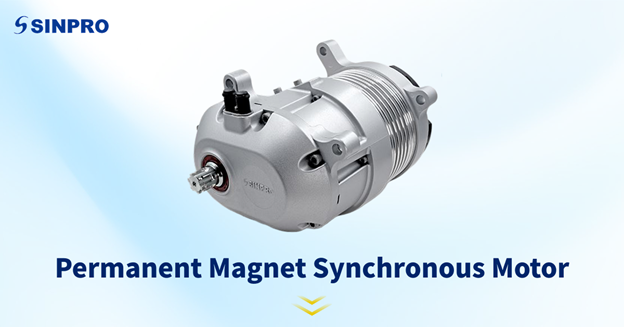
Choosing the right motor is harder than it looks. Many systems need high torque, precise speed control, compact size, and better energy efficiency, but traditional motor options can create trade-offs in performance, heat, and power consumption. This is where PMSM design becomes important. A permanent magnet AC synchronous motor uses permanent magnets and synchronized magnetic fields to deliver efficient, responsive motion. In this guide, we’ll explain its basics, advantages, components, working principle, and key PMSM types to help you understand!
What is a Permanent Magnet Synchronous Motor?
A Permanent Magnet Synchronous Motor (PMSM) is a high-performance AC motor that uses permanent magnets in the rotor to generate a constant magnetic field. When three-phase AC power flows through the stator windings, it creates a rotating magnetic field. The rotor then follows this magnetic field at the same speed, which is why the motor is called “synchronous.”
What are the Advantages of PMSM?
One of the biggest advantages of PMSM is its synchronous operation. The rotor rotates at the same speed as the stator’s magnetic field, without the slip commonly found in induction motors. This enables PMSMs to provide precise speed regulation, consistent torque output, and highly efficient power conversion.
PMSMs also provide high power density. Because the rotor uses strong permanent magnets, the motor can produce high torque and power output within a smaller and lighter structure. This is especially valuable for electric vehicles, where every reduction in weight and space can help improve driving range, layout flexibility, and system efficiency.
Another major benefit is superior efficiency. Since the rotor does not need continuous electrical excitation, PMSMs reduce rotor copper losses and generate less waste heat. This allows the motor to convert more electrical energy into mechanical motion, making it a strong choice for energy-sensitive applications.
PMSMs are also known for quiet and smooth operation. With proper inverter control, the motor can run with smooth torque output, lower vibration, and reduced noise. Since there are no brushes, PMSMs also require less maintenance compared with traditional brushed motor designs.
These advantages explain why PMSMs are especially popular in EV powertrains. They can deliver strong starting torque, quick acceleration, efficient cruising performance, and effective regenerative braking. For manufacturers looking for a compact, efficient, and responsive traction motor, PMSM technology offers a practical balance of performance and energy savings.
What are the Core Components of PMSM?
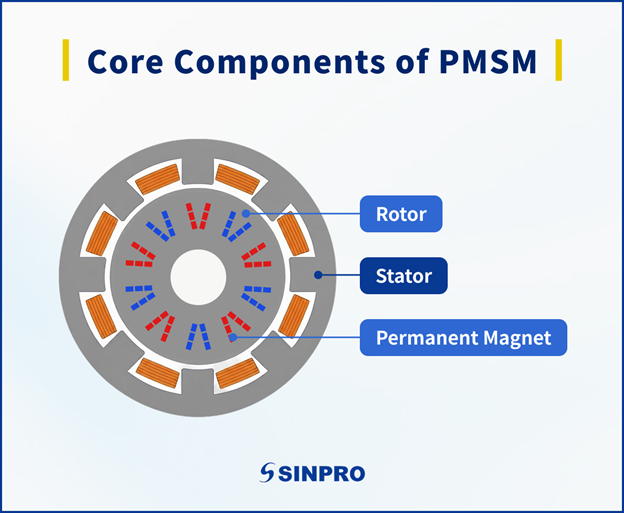
A PMSM electric motor is built with several key components that work together to create efficient, precise, and smooth motion. While the overall structure may look similar to other AC motors, the use of permanent magnets and electronic control gives PMSM its high performance.
Stator
The stator is the stationary outer part of the motor. It contains three-phase copper windings placed inside slots around a laminated steel core. When AC current flows through these windings, the stator creates a rotating magnetic field.
The core is usually made from laminated silicon steel. These thin layers help reduce eddy current losses, which means less energy is wasted as heat. This improves the motor’s overall efficiency and thermal performance.
Rotor
The rotor is the rotating part inside the motor. In a PMSM, the rotor carries permanent magnets that create a constant magnetic field. During operation, the rotor follows the rotating magnetic field produced by the stator.
Because the rotor moves at the same speed as the stator’s magnetic field, PMSM achieves synchronous operation. This helps deliver accurate speed control, stable torque, and efficient power conversion.
Permanent Magnets
The permanent magnets are one of the most important features of PMSM design. They provide a magnetic field without needing electrical power from the rotor. This reduces energy loss and helps the motor operate more efficiently than motors that require rotor excitation.
High-performance PMSMs often use rare-earth magnets, such as Neodymium-Iron-Boron (NdFeB), because they can generate a strong magnetic field in a compact size. This allows the motor to produce high torque while keeping the overall structure smaller and lighter.
Electronic Controller or Inverter
A PMSM needs an electronic controller, often called an inverter or variable frequency drive, to manage motor operation. In EVs, the battery supplies DC power, and the inverter converts it into controlled three-phase AC power for the motor.
The controller adjusts the current, frequency, and phase of the power supplied to the stator. This allows the motor to control speed, torque, acceleration, and regenerative braking with high precision.
Position Sensor
Many PMSM systems use a position sensor, such as an encoder or resolver, to detect the rotor’s exact position. This information is sent back to the controller so it can keep the stator magnetic field properly aligned with the rotor.
Accurate rotor position feedback helps the motor deliver maximum torque, smooth rotation, and stable performance across different speeds and load conditions. In some advanced systems, sensorless control may also be used, where the controller estimates rotor position without a physical sensor.
What is the Working Principle of PMSM?
After understanding the main components of a PMSM, it becomes easier to see how the motor works. The basic principle is the interaction between two magnetic fields: the rotating magnetic field created by the stator and the constant magnetic field provided by the rotor’s permanent magnets.
Three-Phase AC Creates a Rotating Magnetic Field
The process begins in the stator. When three-phase AC current flows through the stator windings, each phase produces its own magnetic field. Because these currents are offset from one another, their magnetic fields combine into one rotating magnetic field inside the motor.
The speed of this rotating magnetic field is controlled by the frequency of the AC power supplied by the inverter. In EV applications, the battery provides DC power, and the inverter converts it into controlled three-phase AC power to drive the PMSM.
The Rotor Follows the Magnetic Field
Inside the motor, the rotor contains permanent magnets with north and south poles. These magnets are attracted to the opposite poles of the stator’s rotating magnetic field. As the stator field rotates, the rotor follows it.
This magnetic locking action allows the rotor to rotate synchronously with the stator’s rotating magnetic field. This is the key reason it is called a synchronous motor.
The Controller Manages Speed and Torque
The inverter or electronic controller plays a major role in PMSM operation. It controls the timing, frequency, and current supplied to the stator windings. By adjusting these factors, the controller can manage motor speed, torque, acceleration, and braking response.
This is especially important in electric vehicles, where the motor must respond quickly to different driving conditions, such as starting, accelerating, cruising, climbing, and regenerative braking.
Field-Oriented Control Improves Precision
Many high-performance PMSM systems use Field-Oriented Control (FOC), also known as vector control. This control method helps the system control torque-producing current and flux-related current more precisely, making motor operation smoother and more efficient.
With rotor position feedback from an encoder, resolver, or sensorless control algorithm, the controller can keep the magnetic fields properly aligned. This helps the motor produce strong torque while reducing unnecessary energy loss.
Common Uses of PMSM
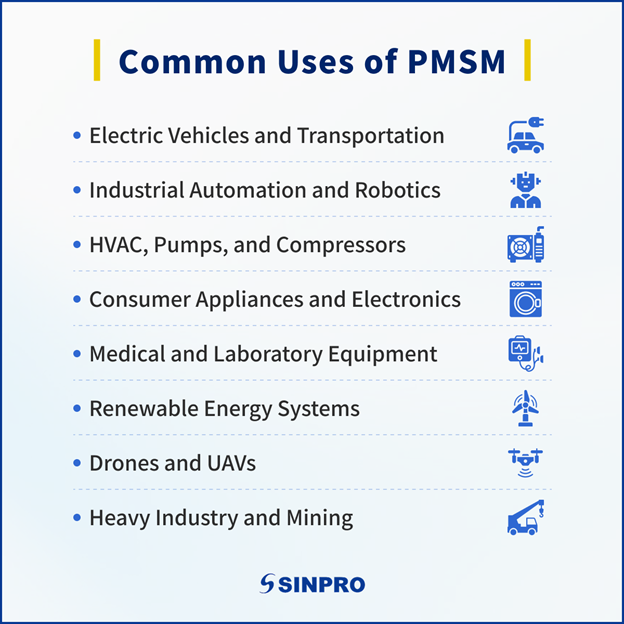
Because of their high efficiency, compact size, smooth operation, and precise control, Permanent Magnet Synchronous Motors are widely used across many modern industries. Common PMSM applications include:
Electric Vehicles and Transportation
As we’ve discussed earlier, PMSMs are widely used as traction motors in electric vehicles and hybrid vehicles. They can deliver strong torque at low speeds, smooth acceleration, and efficient regenerative braking, making them ideal for EV powertrains. Beyond passenger cars, PMSMs are also used in electric power assisted steering systems, vehicle pumps, fans, marine propulsion systems, aerospace generators, and actuators.
Industrial Automation and Robotics
In industrial automation, PMSMs are used in equipment that requires fast response and accurate movement. They are commonly found in robotic arms, CNC machines, conveyor systems, and automated guided vehicles. Their precise speed and position control help improve production accuracy, machine stability, and overall process efficiency.
HVAC, Pumps, and Compressors
PMSMs are well suited for HVAC systems, refrigeration equipment, pumps, fans, and compressors. With variable-speed control, the motor can adjust its output based on real operating demand instead of running at full speed all the time. This helps reduce energy consumption, noise, and mechanical stress.
Consumer Appliances and Electronics
PMSMs are also used in everyday appliances such as washing machines, air conditioners, refrigerators, and ventilation fans. Their quiet operation and energy-saving performance make them a practical choice for home appliances that need reliable and smooth motor control.
Medical and Laboratory Equipment
In medical and laboratory applications, PMSMs are valued for their low vibration, quiet operation, and precise motion control. They can be used in imaging systems, laboratory pumps, analytical instruments, and other equipment that requires stable and accurate movement.
Renewable Energy Systems
PMSMs are widely used in renewable energy applications, especially direct-drive wind turbines. Since they can operate efficiently at variable speeds and reduce the need for additional mechanical transmission components, they help improve system reliability and energy conversion efficiency.
Drones and UAVs
For drones and unmanned aerial vehicles, PMSMs offer a strong power-to-weight ratio. Their lightweight design and efficient performance help extend flight time, maintain stable control, and enable drones to carry sensors or additional payloads for applications such as aerial surveying, agriculture, and infrastructure inspection.
Heavy Industry and Mining
PMSMs are also used in heavy-duty applications such as underground ventilation fans, mining conveyors, industrial pumps, and food processing equipment. Their high efficiency and durable operation make them suitable for systems that need to run continuously under demanding conditions.
Key Types of PMSM: Interior vs. Surface
Rotor design is one of the most important factors in PMSM design because it directly affects torque output, speed range, mechanical strength, and application suitability. The two main PMSM types are Surface-Mounted Permanent Magnet Synchronous Motor (SPMSM) and Interior Permanent Magnet Synchronous Motor (IPMSM).
The main difference is where the permanent magnets are placed. In an SPMSM, the magnets are mounted on the rotor surface. In an IPMSM, the magnets are embedded inside the rotor core. This structural difference leads to different performance characteristics. Let’s learn about these two types with more details:
SPMSM
A Surface-Mounted PMSM (SPMSM) has permanent magnets attached to the outside surface of the rotor. This design is relatively simple and can provide smooth torque output, making it suitable for applications that require precision and stable motion control.
Because the magnets are placed on the surface, SPMSM mainly produces magnetic torque through the interaction between the rotor magnets and the stator’s rotating magnetic field. Its magnetic structure is also more uniform, meaning the direct-axis and quadrature-axis inductances are nearly the same.
However, SPMSM has some limitations at higher speeds. Since the magnets are mounted on the rotor surface, they usually require adhesives or protective sleeves to stay in place. At high rotational speeds, centrifugal force can place significant mechanical stress on the magnets. SPMSMs also have more limited field-weakening capability, which may reduce their performance at higher speeds.
For this reason, SPMSM is commonly used in servo systems, robotics, CNC machines, and other precision-driven applications where smooth operation, simple structure, and accurate control are more important than extremely wide speed range.
IPMSM
An Interior Permanent Magnet Synchronous Motor (IPMSM) places the permanent magnets inside the rotor core. The magnets may be arranged in different shapes, such as V-shaped or U-shaped patterns, depending on the required torque, speed, and efficiency targets.
This embedded magnet structure gives IPMSM several important performance advantages. First, it allows the motor to generate both magnetic torque and reluctance torque. Reluctance torque is produced because the rotor has different magnetic resistance along different axes. This helps increase torque density and improve overall motor performance.
Second, IPMSM offers better mechanical strength. Since the magnets are protected inside the rotor core, they are less exposed to centrifugal stress, impact, or damage during high-speed rotation. This makes IPMSM highly suitable for demanding variable-speed applications.
In advanced IPMSM designs, the controller can also use field-weakening control to extend the motor’s speed range. This allows the motor to operate efficiently across both low-speed, high-torque conditions and higher-speed driving conditions. These features are especially valuable for EV powertrains, where the motor must support quick acceleration, efficient cruising, regenerative braking, and stable high-speed operation.
SPMSM vs IPMSM: Comparison
| Feature |
SPMSM |
IPMSM |
| Magnet Placement |
Mounted on the rotor surface |
Embedded inside the rotor core |
| Torque Production |
Mainly magnetic torque |
Magnetic torque + reluctance torque |
| Rotor Structure |
Simpler design |
More complex embedded design |
| Mechanical Strength |
Moderate, with higher stress on surface magnets |
Higher, because magnets are protected inside the rotor |
| Speed Range |
More limited at high speeds |
Wider speed range with better field-weakening capability |
| Efficiency Range |
Efficient in suitable speed/load conditions |
Strong efficiency across broader operating conditions |
| Manufacturing |
Simpler and often more cost-effective |
More complex and requires precise rotor design |
| Common Uses |
Servo systems, robotics, CNC machines, precision control systems |
EV traction motors, industrial drives, compressors, high-power variable-speed systems |
SPMSM is often chosen for simpler, precision-focused systems, while IPMSM is preferred for high-performance applications that require strong torque, wider speed range, and better mechanical robustness. For electric vehicles and advanced industrial drive systems, IPMSM is often the stronger choice because it supports higher efficiency and stronger performance across changing speed and load conditions.
Power Your EV System with Sinpro Interior PMSM Technology
PMSMs have become an important part of modern EV powertrain design because they combine high efficiency, compact structure, precise control, and strong torque performance. From the basic motor structure to the differences between SPMSM and IPMSM, one key point is clear: choosing the right motor technology directly affects vehicle acceleration, energy efficiency, driving range, and overall system reliability.
Sinpro provides advanced Permanent Magnet Synchronous Motor (PMSM) solutions, including Interior Permanent Magnet Synchronous Motor (IPMSM) designs for demanding EV applications. With embedded magnet rotor designs, IPMSM technology supports high torque density, wide-speed operation, efficient field-weakening control, and stable performance under changing driving conditions. Sinpro's 7.6kW electric motor and controller were also selected for the Taiwan Excellence Awards in 2022, recognizing the technology behind its EV powertrain solutions.
Beyond motor technology, Sinpro extends its expertise to complete electric powertrain architecture. The company also offers key components such as motor controllers, DC-DC converters, and chargers, helping EV manufacturers build more integrated and reliable power systems. Whether you need a PMSM or IPMSM solution or a complete EV powertrain package, Sinpro can support your project from component selection to system integration.
Explore Sinpro's PMSM solutions to learn more about our motor technology, or contact us to discuss the right solution for your application.
Explore Sinpro’s PMSM solutions to learn more about our motor technology, or contact us to discuss the right solution for your application
Contact Us